
Quick comparison: technical specifications head-to-head
Both slots use the classic 3x3 grid and five fixed paylines with left-to-right combination calculations. At the same time, the sequel received updated maximum win indicators and an expanded set of bonus features.
| Parameter | Fire Joker (2016) | Fire Joker Freeze (2021) |
|---|---|---|
| Grid and lines | 3x3, 5 lines | 3x3, 5 lines |
| Wild symbols | 1 (Fire Joker) | 2 (Fire Joker and Ice Joker) |
| RTP (base version) | 96.15% | 96.18% |
| Volatility | Medium | Medium |
| Respin mechanics | Respin of Fire | Respin of Fire + Respin of Ice |
| Bonus round | 1 Multiplier Wheel | 4-level Wheel of Fire and Ice |
| Maximum multiplier | x10 on the wheel | x20 on the wheel |
| Maximum win | 800x stake | 1000x stake |
Despite identical medium volatility, the frequency of bonus feature triggers in the sequel is noticeably higher. This is directly linked to the integration of an additional wild symbol.
Ice Joker and respin mechanics: what changed on the 3x3 grid?
In both slots, base payouts are formed by fruit symbols, X symbols, BAR ingots, stars and sevens. All symbols land in stacks that cover the entire reel. The difference lies in the conditions for activating respins on non-winning spins.
Classic Respin of Fire
In the original Fire Joker, the flame respin triggers under one strict condition: two reels are fully covered with identical symbols, but the spin produced no win. The filled reels lock in place, and the remaining third reel performs one free spin.
If two different reel combinations can trigger a potential respin, the game automatically locks the positions that promise the highest payout. Wild (Fire Joker) performs its standard substitution role and helps form the required stacks.
Dual trigger in Freeze
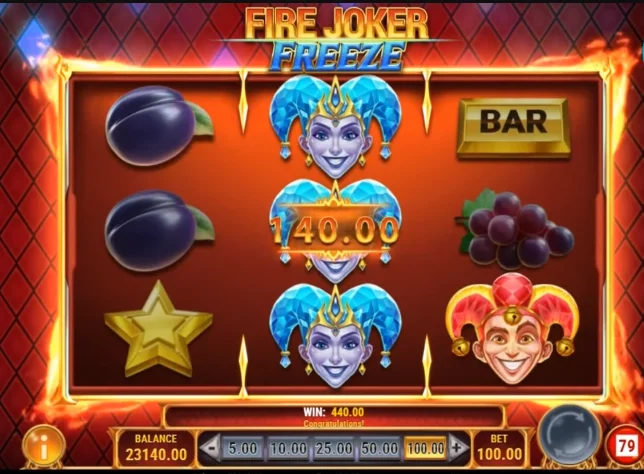
The sequel retains the classic Respin of Fire under the same rules but adds a separate Respin of Ice mode. This mechanic is handled by the Ice Joker, which acts as an Expanding Wild.
- Ice Joker lands without a win: if the ice symbol appears in any position on a non-winning spin, it expands into a full-reel stack.
- Reel lock: the reel with the expanded Ice Joker freezes in place.
- Respin of remaining positions: the other two reels receive a respin, increasing the chance of covering the grid with matching symbols.
- Early stack collection: if two reels already display matching symbols and only a single Ice Joker lands on the third reel, it immediately expands into a stack and triggers the bonus round without a respin.
This combination makes the sequel more dynamic: empty rounds in Freeze more often turn into winning combinations thanks to the forced expansion of the ice wild.
Bonus wheel battle: x10 multiplier vs 4-level Wheel of Fire and Ice
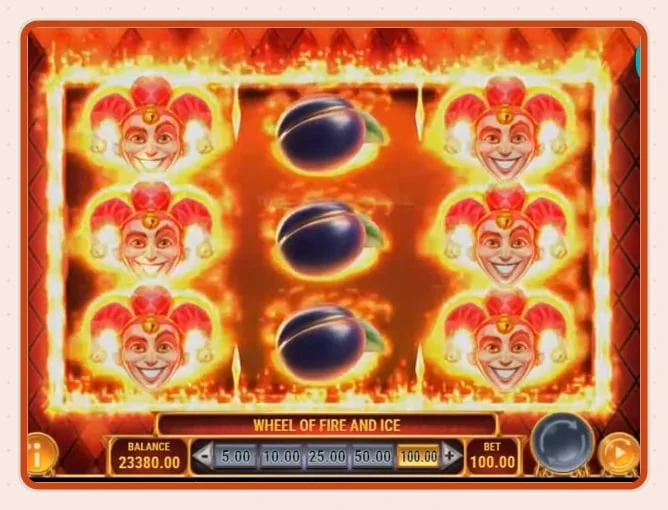
The main objective in both slots is to fill all nine grid positions with the same symbol. In the original, a screen of nine identical symbols (including wilds) immediately launches the Multiplier Wheel. The player receives one spin with values x2, x3, x4, x5, x6, x7, x8, x9 or x10, which multiplies the total win across all five lines.
In Fire Joker Freeze the concept has been reworked: the Wheel of Fire and Ice consists of four nested levels. A base trigger starts at the inner ring, but the presence of Ice Joker stacks grants an instant level upgrade:
- Wheel 1 (start without Ice Joker): sectors x2, x3, x4 and the “Snowflake” symbol (advance to level 2).
- Wheel 2 (start with 1 Ice Joker stack): sectors x3, x4, x5 and the “Snowflake” symbol (advance to level 3).
- Wheel 3 (start with 2 Ice Joker stacks): sectors x4, x5, x6 and the “Snowflake” symbol (advance to level 4).
- Wheel 4 (start with full Ice Joker screen): only final multipliers x6, x10 and the maximum x20.
Landing on a snowflake sector removes the current ring and grants an additional spin on the next wheel level. While the original slot strictly capped the bonus multiplier at x10, the four-level structure of Freeze allows payouts to reach x20.
Mathematics and payout dynamics: which slot should you choose?
The difference in slot behaviour is felt in session length and variance distribution:
- Classic Fire Joker: features a predictable mathematical model. Respins occur less frequently, but the bonus wheel decides the round outcome with a single spin. This version suits fans of strict old-school gameplay without complicated multi-stage transitions.
- Fire Joker Freeze: thanks to the Ice Joker expansion mechanic, empty spins are interrupted much more often. The win ceiling has been raised from 800x to 1000x stake. At the same time, bonus wheel volatility is higher: advancing to the fourth level carries the risk of landing on the lowest multipliers of earlier wheels.
To evaluate the updated dynamics, it is enough to test both slots in demo mode and compare the frequency of Respin of Ice triggers with the classic spins of the original version.

Lucas Hayes
I'm Lucas Hayes, a gambling writer with a focus on slot mechanics and player experience. I review titles like Fire Joker Freeze, breaking down respins, multipliers, and jackpots into clear, actionable insights. My goal is to help you understand the game before you play for real money.